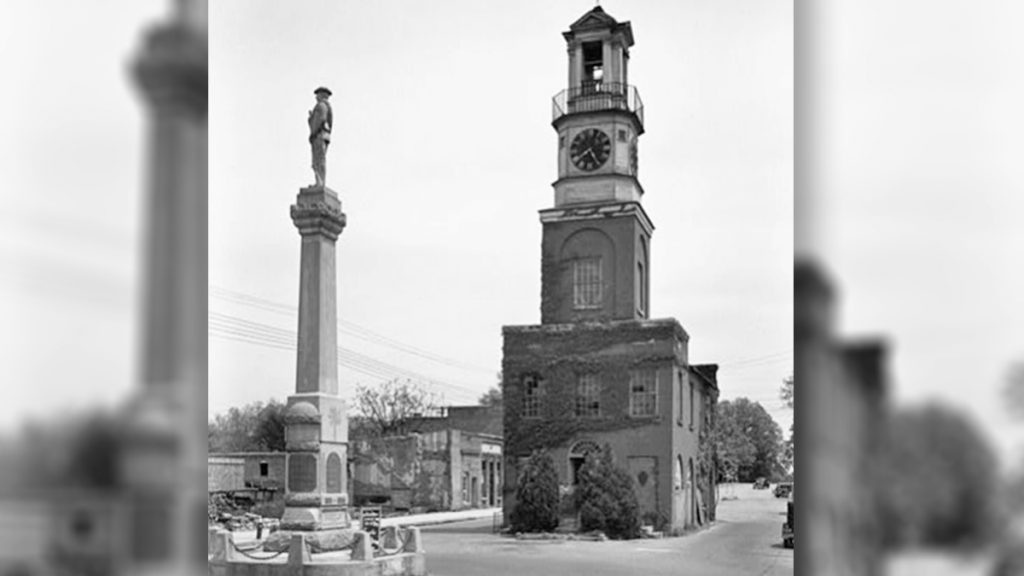
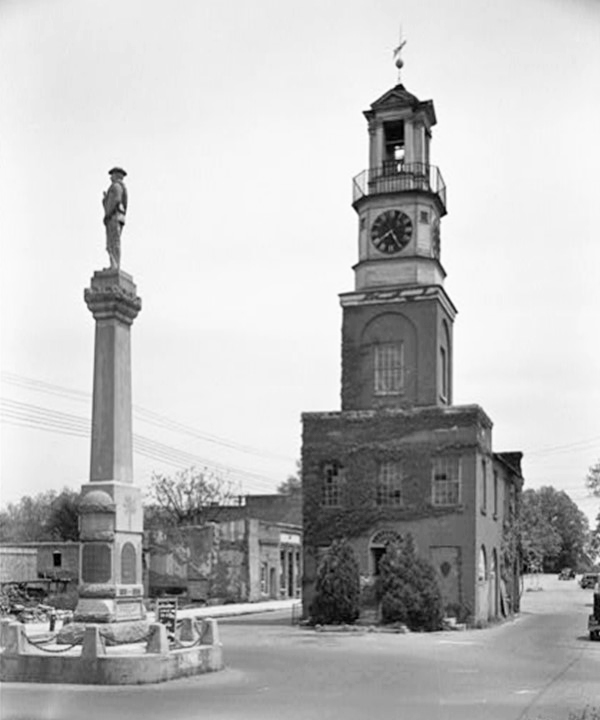
FAIRFIELD COUNTY – The Winnsboro town clock did not arrive all at once.
In 1837, its machinery was ordered from Alsace, France, shipped through Charleston, and then hauled inland to Winnsboro by wagon. That work fell to a Black man named Adam Blake, identified in the historical record as a freedman.
The clockworks were heavy. Exacting. Dependent on hands willing to move them mile by mile across the countryside.
The pieces arrived first.
What Adam Blake carried was not simply machinery. He carried the mechanism by which the town would regulate itself for years to come. Time entered Fairfield County through Black labor long before it announced itself through chimes.
By 1837, the market house tower stood ready to receive the clock. The machinery had arrived. The structure awaited its purpose.
The installation itself was work, not ceremony. Heavy components were lifted and secured. Precision mattered. Failure was not an option. When the mechanism was finally set in place, the clock began to regulate the daily life of the town.
Time entered Fairfield County quietly.
There is no public record naming who climbed the tower that day. No dedication plaque. No formal acknowledgment. What mattered was that the clock worked, and that it would continue to work long after the labor that installed it faded from memory.
This was not the last moment Black hands would be trusted with the clock.
By 1875, the tower showed signs of weakness. Brick alone was not enough to hold what the town had come to depend on. The solution was not cosmetic. It was structural.
The tower was stabilized through internal wooden buttressing, a timber framework built inside the brick walls. The carpentry work was done by John Smart, identified in the historical record as a well-known Black craftsman in Winnsboro. A measured drawing of this internal framework survives in the museum collection.
It is because of John Smart’s work that the clock still stands today.
The public face of the tower did not change. The labor that preserved it remained invisible. The structure endured because the work was done correctly.
But that trust did not necessarily translate into credit.
The town clock remains the most recognizable structure in Fairfield County, but it does not explain itself. Its brick face suggests permanence. Its chime suggests order. What it does not announce is the labor required to make it work.
The parts of the clock were heavy. They had to be carried, lifted, installed, reinforced. Precision mattered across the decades.
Across Fairfield County, Black labor followed the same pattern. Skilled work was relied upon and quietly absorbed. Roads were cleared. Buildings were raised. Churches expanded. Schools were repaired. Homes were built sturdy enough to last beyond their owners.
Black people knew how to build things that endured.
Black craftsmen were known locally for what they could do.
Reputation moved through word of mouth, not contracts.
Skill circulated without documentation.
Under slavery and after emancipation, Black labor helped sustain Fairfield County while ownership, credit, and formal decision making remained restricted. Tenant farming replaced bondage. Wage labor replaced ownership.
Labor knowledge was passed alongside values of responsibility and endurance.
The Town Clock is not unique because it stands.
It is unique because it reveals how the county stands.
A Black man hauled time into place. Unnamed labor installed it. A Black craftsman preserved it from collapse. A town benefited and moved on. The structure endured.
Fairfield County is filled with buildings like this. They do not announce who made them possible. They simply remain.
To understand the county honestly requires looking past the landmark and into the labor. The durability of Fairfield County was constructed, reinforced, and handed down by people whose names were often left out of the record but whose work still holds the place together.
That truth does not weaken the county’s story.
It completes it.