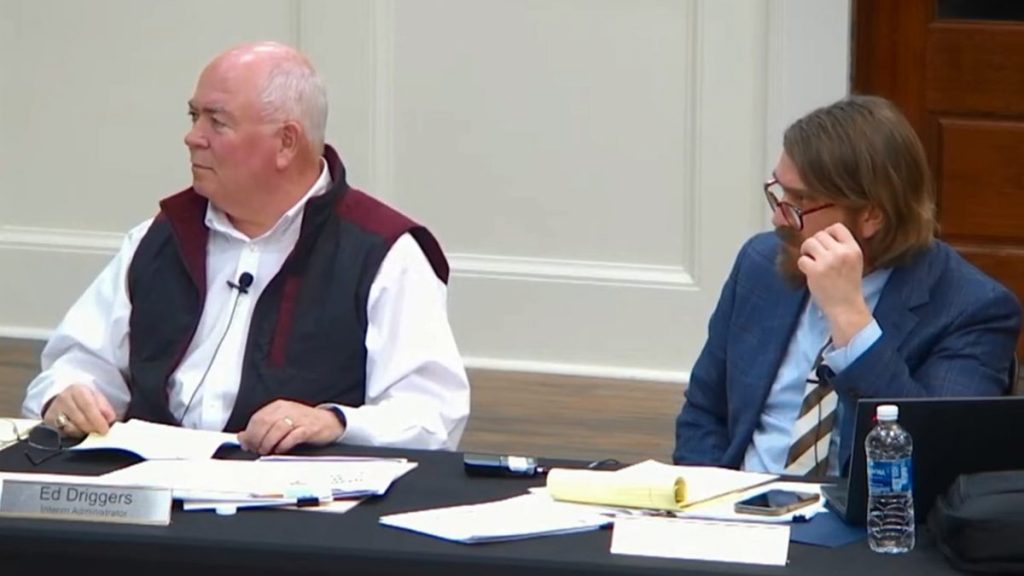


BLYTHEWOOD – Blythewood town hall charged The Voice $500 to answer a Dec. 19 FOI (Freedom of Information) request concerning a $20,000 hospitality tax award. During the Nov. 24 town council meeting, Councilman Donald Brock said that the $20,000 “walked away and it isn’t being accounted for.” At the Jan. 28 town council meeting, Council members called on the Town’s Interim Manager Ed Driggers and Town Attorney Pete Balthazor to explain the $500 FOI charge.
Driggers said neither he nor the town staff can search and retrieve emails in answer to FOI requests. He said that’s because the Town uses a third-party vendor, ATG (Asset Technological Group), to manage and store emails. He said requests for emails must be searched and retrieved by the vendor, a service for which there is a $500 minimum charge, according to Driggers and Balthazor.
Columbia Media Attorney Jay Bender, who represents the S.C. Press Association, questioned that arrangement.
“It appears that by placing the Town’s email records with a firm not subject to the Town’s control, the Town is violating state law in two regards,” Bender said.
“First, the custodian of public records is to keep them secure in such ‘arrangement as to be easily accessible for convenient use.’ The Town has failed to do this,” he said.
“Second, the law requires records to ‘be kept in the buildings in which they are ordinarily used’ with exceptions that have no bearing on this situation. The town has failed to do this.
“A refusal or willful neglect of duties with respect to public records is a misdemeanor,” Bender warned.
How did $500 FOI Fee Materialize?
When asked by Councilman Donald Brock, at the Jan. 28 council meeting, to “point to where in our agreement with ATG is language that says they charge $500 or some sort of fee for these searches,” Driggers replied, “It’s not there.” He said the CEO of ATG told him it’s ATG’s policy to charge a minimum $150 per hour for a minimum of two hours to search and retrieve emails. He did not explain how that equaled $500.
“If I have a third-party contractor and it’s the only way that I can get the work done, is that $150 per hour under the FOI Act?” Driggers asked. “Maybe it is. Maybe it isn’t. I don’t know the answer.
“I’ve communicated with the CEO of ATG,” Driggers continued. “All of my conversations prior to the one this week were at $500. This week we’re talking about $300.”
“Copy charges may not apply for records transmitted electronically,” according to Sec. 30-4-30 of the statute.
There is also a provision under 30-4-30 to provide documents free when the information is primarily benefitting the general public, as in news reports.
The Request
The Voice asked for emails between named individuals, not a keyword search, but Driggers said he was unable to understand what was being requested.
“If I can understand better what we’re trying to accomplish, I can look for solutions to do that,” he said.
“This council has strived to be transparent,” Councilman Rich McKenrick said. “The easiest route we can take is to be as transparent as we can be, as quickly as we can. It plays to our credit. And if it doesn’t, shame on us.”
Complying with FOI Act
“So, are we still complying with the state statute on an FOI request if what we charge is not for the lowest hourly paid employee that can reasonably do the work as required by law, because we have a third party vendor?” McKenrick asked Balthazor.
“Correct,” Balthazor replied. “That is my belief.”
Balthazor, who notified The Voice of the Town’s $500 charge, claimed at the Jan. 28 council meeting that the Freedom of Information Act provides multiple ways for governments to charge for FOI responses.
“If we’re doing it [searching and retrieving emails] in-house, what we can charge is the prorated hourly salary of the lowest paid employee who has the necessary skill and training to perform that,” Balthazor explained. “But, if we can’t do it in-house, we have to go out of house to be able to get those services. The FOI Act says we can collect reasonable fees not to exceed the actual cost of the search, retrieval, and redaction of records.
“To me,” he said, “that’s what the third-party vendor is doing. It is doing the search and retrieval of those records. And it’s saying, ‘Town, it’s going to be $500 or $300, whatever it is now’ …I understand the transparency, the freedom to obtain records, but if that’s a cost to the Town, I certainly was not at liberty to waive any cost to the Town in that situation.”
“As for the town attorney’s assertion that there is a two-tier scheme for searching for and making records available, I would like for him to identify the code sections to support his position,” Bender said. “I do not believe such a scheme exists.
“The law requires public bodies to create document retention plans in cooperation with the South Carolina Department of Archives and History” he said. “I suspect Blythewood does not have a plan that conforms to state law.”
The provisions of law referred to by Bender are found in Sections 30-1-10 through 30-1-140 of the Code of Laws of South Carolina.
Failure to Post Vendor Costs
Council members pointed to myriad problems with the town administration’s approach to accommodating FOI requests.
“First, we should know what the costs are,” Councilwoman Trish Hovis said. “South Carolina law says we must publish our FOIA fees. Our website doesn’t address a third-party vendor. How do all those other governments search and retrieve somebody else’s email? Somebody must be able to get into email because other governments provide those responses all the time in-house,” Hovis said. “Review how do you provide in-house emails if it’s a privacy situation and you can’t go in my email, and I can’t go in yours? Well, somebody does that somewhere.”
Driggers Points to Abuse
Driggers redirected the narrative to those FOI requestors who, he says, abuse the FOI.
“I can give you example after example after example where it has been abused,” Driggers said.
“But in this case, it is the CEO of the company changing the numbers,” Councilman Rich McKenrick countered. “[The cost is] different now than what we were told by that vendor to give a media outlet. It’s not a good look for the CEO, the company or for the Town. Somebody’s got to clean it up.”
Hovis Challenged Abuse Inference
“Somebody’s abusing the FOI?” Hovis asked Driggers. “Were you referring to the media? Who’s abusing it?”
“No one here,” Driggers said.
Different Charges for Different People
Town Clerk Sharon Durst spoke up, recalling that ATG searched and retrieved FOI requested emails from her computer at no charge.
“They said if they [ATG] searched certain keywords, there would be a charge for that,” Durst said.
The Voice also did not ask for a keyword search, just emails between identified individuals, but was charged $500.
“So, now, we’ve got a little bit of conflicting information here,” Brock said.
Ending the discussion, McKenrick questioned Driggers and Balthazor concerning the Town’s current FOI policy.
“Our current policy says 10 cents a page, $10 an hour,” Driggers said. “That’s in-house.”
“Ten dollars per hour per staff member,” Balthazor added. “Now, per staff member may not be correct, but I think that’s referring to internal town staff.”
“I’m assuming our current policy does not address third-party vendor fees,” McKenrick said.
“It does not,” Balthazor said.