WINNSBORO – Several county business owners pushed back Monday night at the prospect of council considering a business license on businesses in the unincorporated areas of the county.
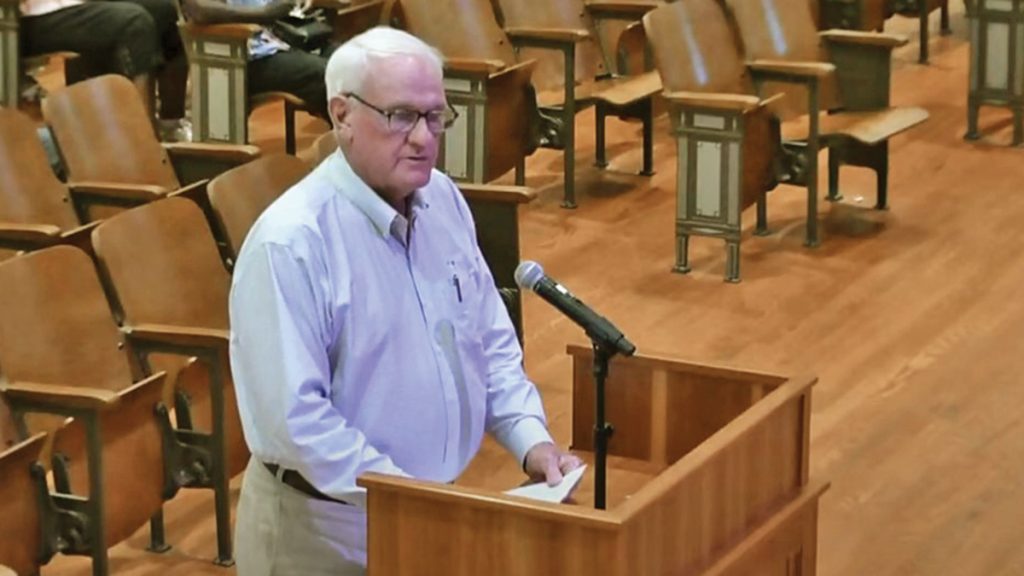
Fairfield County Farmer William Coleman was one of four county residents who spoke during public comment at Monday night’s county council meeting.
“I’m against a business license that was discussed by council’s administration and finance committee last week,” Coleman said. “The Voice reported that Community Development Director Joseph Toledo explained …that the business license could come with a fee that would be based on each business’s gross income – that’s gross income – and would provide authority to the county to audit and regulate businesses. To begin with, the idea of gross income scares me. Even IRS allows for deductions for expenses. There’s a strong possibility this fee could be detrimental to me in my farming operation, since profit margins are very slim. And unlike most other businesses, I’m not able to pass that fee on in the sale of my products. I especially don’t like the idea of the county being able to audit me. I urge you council members to scrap this plan before going any further.”
Kerry Matthews, whose family owns a cattle ranch in White Oak agreed with Coleman.
“[A business license would] seemingly be a virtual county income tax,” Matthews said. “Like Mr. Coleman, my family farms, and a farm’s gross income can look tremendous, if you’re not considering the tremendous costs of the business. That’s unreasonable. It could also have a negative impact on growth in the county if you’re charging people who are wanting to have businesses in the county. It just seems like a shameless grab for money by county council. I hope it will not pass, and will stop tonight. I’m disappointed that it made it out of committee. I hope that it will be put to bed tonight,” Matthews said.
Lifelong Fairfield County resident James Joiner, a retired deputy sheriff and now a farmer, questioned how a business license tax would affect Fairfield farmers and its agriculture industry.
“I raise beef cows and train horses,” Joiner said. “I spend my days either in a saddle or on a tractor. Farming is not done to make money. There is no money to be made in farming. All you do is hope to break even. More taxes on a farmer is not the way to go. This is a rural county, an agricultural county. If this new license and tax is going to affect agriculture, then I would hope it either fails or that the council takes that into consideration and makes amendments or waivers for agriculture. That’s how we survive,” he said, “on tax exemptions and waivers. And without them, there’d be no farmers in the country. You can’t tax a farmer. There’s no money there for it to be taxed. You do that, you’re going to lose that farmer and we lose our food for our nation. I just want you all to understand that.”
Non-farmer Randy Bright wrapped it up, stating that, “A business tax is an impediment to jobs, to growth, and overall healthy economy. Let’s not forget that Fairfield County has high unemployment already, 25% higher than the state average. We also have a high poverty rate. We also have a low labor participation rate, and a low average income rate compared to the rest of the state. We don’t need impediments for jobs and growth. Why would we burden businesses? Why would we erect a barrier to businesses that they don’t have in 36 other counties? Why has the majority of the counties in South Carolina just said no we want to have nothing to do with a barrier to business? We should want to grow our business …not tax them,” Bright said.
After a couple of council members also spoke out against a license fee for the county businesses, County Administrator Vic Carpenter, attempted to put the issue to rest.
“A discussion was held [during the Aug. 14 Administration & Finance Committee meeting], but the item is not in front of the council at this point for action,” Carpenter said. “The discussion on the business license has a lot of interest. [During the committee meeting] the discussion focused on the fact that this is an item that has merely been proposed for consideration. It is something that has to be researched and would need effort put into it by staff as well as the public before the council would receive it,” Carpenter said. “I don’t see it coming before the council in any form anytime soon.”