Carpenter Explains What it Would Mean for Fairfield
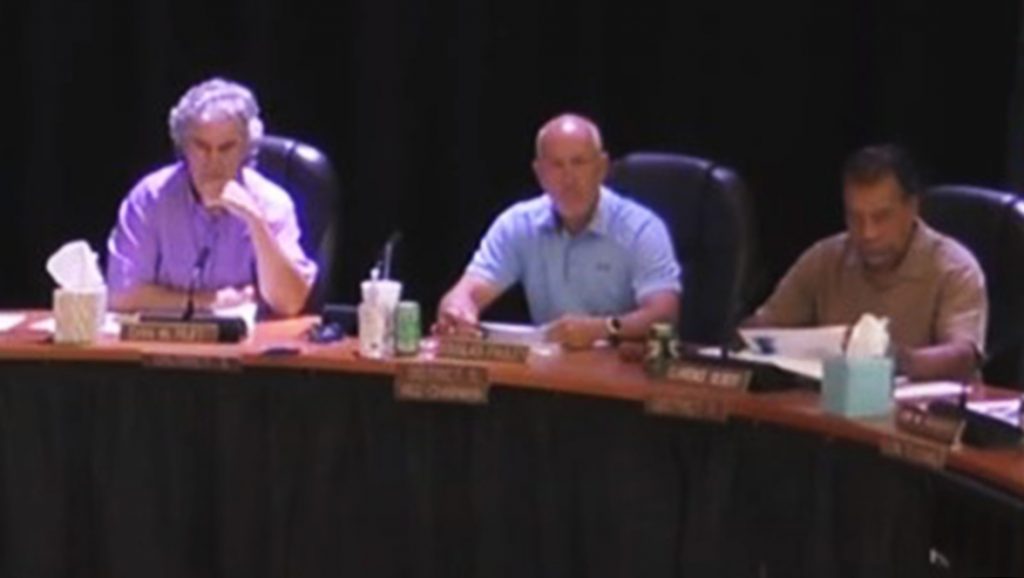
FAIRFIELD COUNTY – During a special called meeting Monday night of the Fairfield County Council Administration & Finance Committee, County Administrator Vic Carpenter laid out for the committee what a capital projects penny sales tax for Fairfield County would look like and how it would work for the county.
The committee included Chairman Clarence Gilbert, and Council Members Doug Pauley, and Dan Ruff. At the end of Carpenter’s presentation, Ruff called for a vote. The vote was unanimous and sent the matter to council without a recommendation for or against.
Carpenter opened his presentation saying, “It has been discussed that we look at creating a capital project sales tax,” and proceeded to lay out the process and promise of a capital project penny sales tax.
“A capital project sales tax is a creation of the general assembly that allows communities to add a penny sales tax to the retail sales in a community in which those funds must be spent for specific projects that have been identified. It has to be approved through a referendum of the general public that can only be held in a general election,” he said.
If council should vote to pass the tax, the referendum would be held during the November 2026 election.
Before then, however, Carpenter explained that county council would have to pass a resolution authorizing the creation of a commission that would then lead to recommendations for the projects. This commission is required by state law.
“There would be six members of the commission,” Carpenter said. “Three are appointed by the county council, two by the main municipality, and one by the other municipalities.”
“The commission will then prepare a slate of projects for both the county and the towns,” he said, “with suggestions coming from county, towns, even approved nonprofits.”
Those projects are then presented and reviewed by the commission who selects a slate of projects that go before the county council. County council can vote them up or down.
Carpenter said he reached out to determine how much the County would be able to bring in with the tax.
“Right now, it looks like we’re generating a little over $3 million a year from the current local option sales tax. The project penny tax would be the same parameters,” he said. “By law, you can only do your first one for a total of eight years. With the expected growth in the value of one penny tax, over an eight-year window, we would look to probably bring in about $30 million of revenue that we would be able to spend.
“Part of the ballot question will normally ask if the public wants to allow that revenue to be bonded up front, or if it wants to be ‘pay-as-you-go.’ Generally speaking, there’s one main reason why you bond it up front – to get the projects done quicker and cheaper,” Carpenter said.
“So it’s normal that you’ll see a bond package approved, and then the projects are done,” he said. “It requires a careful management of those projects so that you don’t commit to projects that you then cannot build and conduct.
“There’s general advice that since you’re dealing with a commission that represents the entire county, the projects will generally have to benefit the entire county.
“So there’s a variety of projects that could be funded by a capital project sales tax. But, ultimately, it requires the voters to approve it,” Carpenter explained.
“To communicate a project like this, an organization is created of a group of citizens. The law is specific that county officials cannot advocate for it or use county resources for it. Now, we can answer questions about the projects and the process, but I’m not allowed to write op-eds for or against the project or advocate for or against it. A group of citizens does that for you. And they have to raise the money on their own to fund it.Lots of town halls, lots of communication are needed with our citizens to talk and explain and to help them understand the projects that are presented to them.
“It’s probably the most effective way of accomplishing projects that are beyond the ability of most counties to pay for,” Carpenter said.
Some towns would not have been able to provide for ball fields, walking tracks, animal shelters, and things like that.
“And this way of raising funds does not affect our bonded indebtedness, so the 8% limit does not come into play here.
“Upon the completion of a successful sales tax election,” Carpenter said, “you would start the process of bidding them out, going out and designing and bidding.”
To accomplish all this, he said, council would need to pass a resolution authorizing the beginning of the process, and then create the necessary infrastructure for the council to appoint its members of the commission, the municipalities to appoint their members of the commission, then the creation of some organization to raise funds.
“Sometimes it’s an existing organization, like the Chamber of Commerce, that will do the promotion. But that’s up to the will of the council,” he said.
“So our part of it at that point is just coming up with the projects, making sure the projects are engineered correctly, and we’re answering all the questions.
“The marketing organization is out there promoting to the community why this is a good thing and why it will benefit us if we do it,” Carpenter said.
“And then, of course, would come the actual election in November of next year,” he said. “The tax is not just on our citizens. A lot of this revenue comes from outside the county, from tourists, from all over the place.”
“So I’d be in favor of going forward with this,” Ruff said, then followed with a motion to move forward. Pauley seconded the motion and the vote was unanimous to send the matter to council to review and discuss.
Carpenter said the issue will be presented to council at a later date.