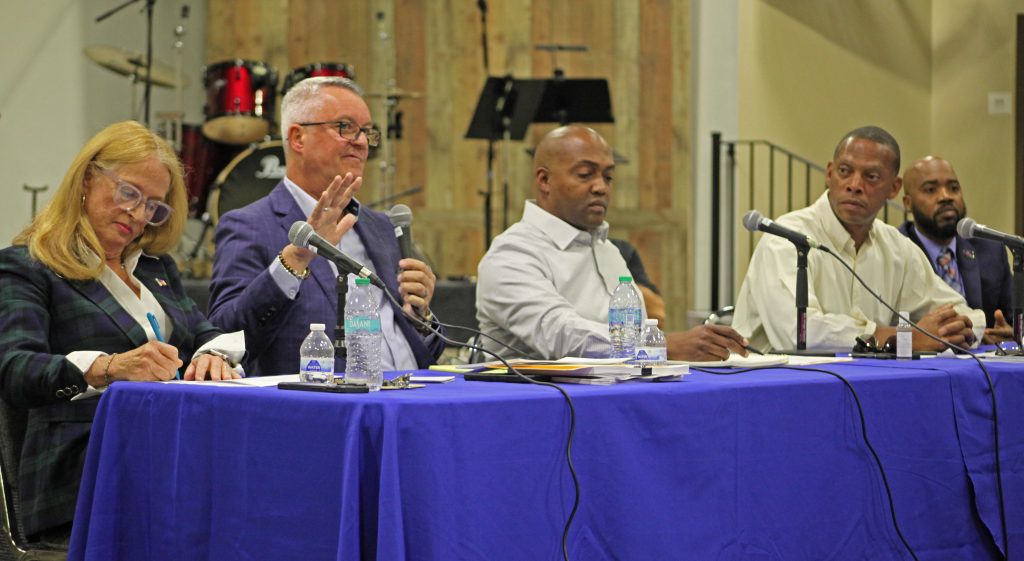
BLYTHEWOOD – Five candidates for Blythewood town council shared their views Monday night in a public forum moderated by the town’s first and longtime town attorney, Ted Von Keller with Columbia law firm Crawford and von Keller.
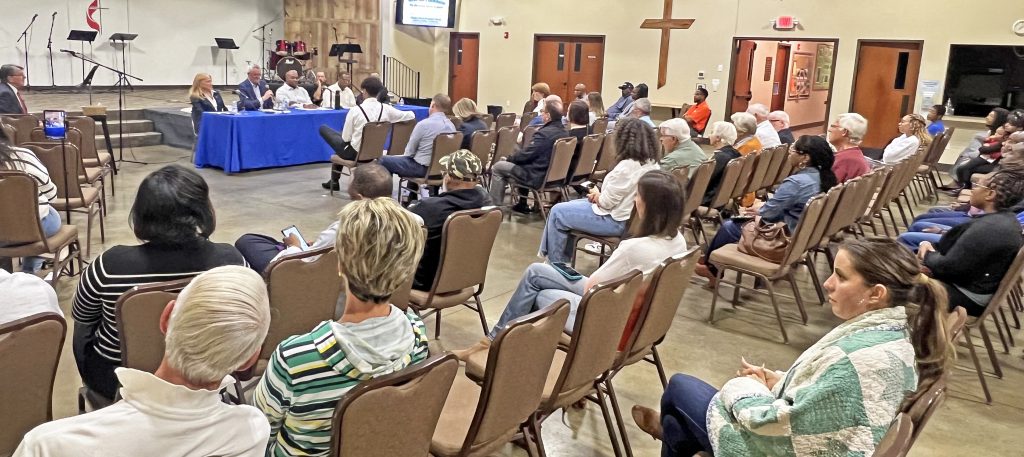
More than 60 people attended the forum which was sponsored by The Voice and held at Trinity United Methodist Church’s Youth Building on McNulty Road in Blythewood.
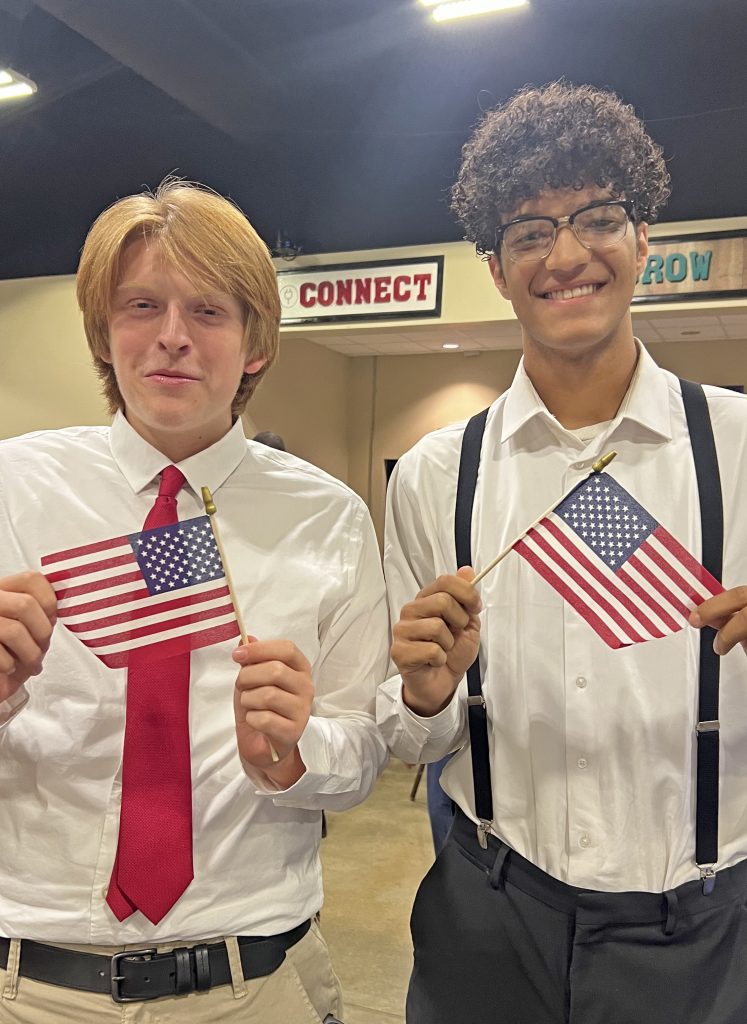
Timers were Blythewood High School student Zaire Collins and Westwood High School student Jackie Smith.
The panelists featured Trish Hovis, incumbent Rich McKenrick, Corey Mitchell, Ja’maal Mosely, and Marcus Taylor, each responding to questions submitted by the audience. Questions could be asked of all the candidates or just one.
The forum was live streamed. The video of the opening and closing statements and the candidates’ answers can be viewed on The Voice of Blythewood and Fairfield County’s Facebook page.
Here is a summary of some of the questions asked by members of the community with the candidate’s answers.
Did you support the change from a mayor-council to a council-manager form of government?
Hovis: “I supported the referendum. [It] was necessary, because we have leadership that is not performing to standard as it relates to public funds and the reputation of the town. I don’t believe that leadership and town council had a working relationship such that they could produce results.”
McKenrick: “Yes, I did support the referendum. In my tenure on council, we operated for the most part under a council-manager form of government until probably last year when our current mayor kind of took over things. Everybody started reporting to him. He took over staff meetings, and started to go down a slipper slope. The council had no trust.”
Mosely: “When we voted in July, I was opposed. My opposition was not against the form of government. It was against the timing and the tact, because it made it very clear that we also wanted to have more education.”
Taylor: “So one person’s going to be held accountable for anything bad that may happen to them. So we’re going with whatever people want. That’s what we’ve got.”
Mitchell: “So I voted yes… All I want is for us to get up there and get together, share the community, bring it back to us, talk about it, and then come back out as one. So when we come back in front of you guys, there’s no confusion.”
If elected, will you commit to not raising the salaries of the mayor and town council members?
Hovis: “No I would not do that [raise salaries].”
McKenrick: “I would vote against raising council’s salary.”
Mitchell: “I can’t say I would commit to that. We will sit down and talk. If it’s in the budget or if it’s feasible, is that what we need to do? Yes. If not, no.
Mosely: “I cannot make a decision without …I’m willing to discuss it with residents and council. I’m willing to examine the budget and based on those findings, willing to vote. So I can’t say yes or no without those two precursors.”
Given the reports of the financial losses at the Manor, what should be done to prevent or mitigate future losses and to hold responsible those who contributed to the losses responsible?
All five candidates agreed that the town’s pricing structure should be adhered to.
Taylor: “Basically, it’s up to the town. I’m not in it for the money. If you guys want to give us a raise when it’s time, if it’s in the budget, fine. If not, that’s fine, too.”
Hovis: “When you have somebody that comps, gives away the manor, that’s not the leadership style that I would employ, that comps the manor for somebody to have a birthday party because of a relationship. If you say, ‘I don’t know, that’s what my staff does’, and then we get documentation that comes out showing that you actually did approve that. That needs to be eradicated.”
McKenrick: “Council has absolutely no means to stop the mayor from comping the Manor until Nov. 26. A town ordinance (law) establishes the structure. The mayor ignores that ordinance. That’s why the referendum was important. On Nov. 26, we’ll mitigate the losses at the Manor. We’ll change from a strong mayor who gives the manor away, to a council-manager form of government. That manager is then accountable to council. It will stop.”
Mosely: “We must come to agreement on how much it costs to use a system that does not allow someone to receive personal funds to their personal accounts for someone to request that property. I think that’s where we start. In terms of holding folks responsible, what’s the statute of limitations on that? Are we gonna go back to a full investigation back in 2015 and hold all parties accountable, or are you just talking about what’s happening in the news right now?”
What is your position on expanding town residency to people currently not annexed into the town?
All candidates agreed that just living in Blythewood 29016 does not necessarily allow a person to vote in town elections. All candidates agreed that those whose properties are contiguous with the town limit border could petition the Town to be annexed, thus enabling them to vote in town elections.
Taylor suggested changing the law so that everyone in 29016 can vote in the town elections. [It is a state law, not a town law, that states that only those people who live within the town limits are allowed to vote on town issues. That law cannot be changed by town council.]
Mr. Mosley, could you please explain a comment you made in response to an article about the Blythewood referendum that appeared in the Minority Eye? After you asked if the people wanted you to run for town council to shake things up, you next said, ‘Make way for the S1Ws.’ Who, what is the S1W?
Mosely: “It is a music reference to hip-hop group Public Enemy’s song lyric, ‘Clear the way for the S1Ws.’ “He said it has no political meaning and is “like saying Geronimo or Yippee.” The person who asked, questioned that explanation.
Another man in the audience pressed for a definition of S1W. “What are you talking about?” he asked.
After several minutes of questions from the audience as to ‘what is S1W,’ Mosely gave several answers, including: “it’s a catch phrase by a music group.’
“My time is up,” he said at one point.
According a Google AI overview, “S1W stands for ‘Security of the First World’, a group that was part of the hip-hop group Public Enemy. S1W was known for their military style uniforms and synchronized performances, which included martial arts, military drills and show-step dances. They represented discipline, purpose, and power, visually embodying the group’s message of Black empowerment and resistance.”
Should council members visit all businesses in town?
All five candidates agreed that council members should visit all businesses in town.
Mitchell pointed out, however, that not everyone can enter some businesses in town. With his own accessibility experiences in mind, he noted that some of the town’s businesses are not wheelchair-accessible and he would like the town government to help owners make improvements to become ADA compliant.
What are your priorities for police, fire, and emergency responses in the town as the population grows?
All candidates said they realize the town can’t afford these departments now, and that the town has intergovernmental agreements with the Richland County’s sheriff’s department, EMS, and fire service. The town contracts its water services from two sources, Winnsboro and the City of Columbia.
Mitchell and Mosely noted that Scout’s bringing in 4,000 or 5,000 people, and that the likelihood of public safety incidents, whether they are highway accidents or some sort of safety or industrial accidents, will require first-inning emergency responders and the Town is going to eventually need a police department.
McKenrick stated that a police department in Blythewood would cost more than the sum total of the town’s entire annual budget. “If Blythewood wants a police force, then we’re going to have to levy a millage or find another sustainable source of revenue.”
What is your long-term plan for the town’s growth in the next five to 10 years?
All five candidates agree that the town’s comprehensive plan is the ticket for long term planning for the town as Scout is likely to bring exponential growth to the area.
Hovis talked about Blythewood’s comprehensive plan in terms of the town’s Town Center zoning. “Town center meaning vibrant, a little restaurant, places you want to go and feel happy about and take your family, not light industrial. So, I just wonder why Mr. Mosely [planning commission] just recently recommended that town council change town center zoning to light industrial for U-Haul? Fortunately, town council shot that down. Let’s follow the comprehensive plan.
McKenrick said the comprehensive plan is our long-term plan for growth. “If you don’t like what it says, you can’t drop back and punt and say, we’re going to re-set the comprehensive plan because we’re on the Planning Commission and that’s what we can do. No, the comprehensive plan is there for a reason. Please use it.”
Mitchell says managing rapid growth begins with listening and working to ensure that the necessary resources and critical infrastructure are in place to meet the demands of the changing demographics. Growth should strengthen our community and preserve what makes Blythewood a place where we’re proud to call home.
Mosely says the comprehensive plan was designed so that we could prepare for the future. “We need to look at it, accomplish, check, and adjust,” he said.
Taylor said we need to definitely go back and revisit the comprehensive plan.
Are there plans to improve pedestrian and bike access to downtown or community areas?
Hovis said this is what the City of Columbia is doing to try to attract young people to stay there when they graduate college. “Young people like a walkable area where they can walk to restaurants, clubs, and shopping,” she said.
Mitchell said he had not seen any plans. The other four candidates, three of which have served or are serving on the planning commission, said the town’s comprehensive plan provides green space, sidewalks, bike paths, walking paths and other outdoor amenities.
McKenrick said it has an entire section dedicated to walkability and Blythewood becoming pedestrian and resident friendly. He said the County’s Penny Tax plan (TPAC) has paving projects for road widening, and bike paths are part of that road widening project.
Mosely said the town purchased 37 acres to expand Doko Meadows Park for outdoor activity.
The election is set for Tuesday, Nov. 4.