FAIRFIELD COUNTY – If Fairfield County and its towns decide to ask voters for a one-cent capital project sales tax, they should expect a full-blown campaign, not a quiet housekeeping measure.
That was the message Thursday morning as Sumter County Administrator Gary Dixon and Sumter City Manager Darren McCormick walked Fairfield County officials through how Sumter’s penny tax has passed three times – and failed once – over the last two decades.
“This is a campaign. This is like an election,” Dixon told county council members and staff. “You’ve got to know how to play the game and know all the players and know the key talking points.”
McCormick said Sumter’s successes – and its one high-profile failure in 2022 – had less to do with the projects on the list and more to do with trust and communication.
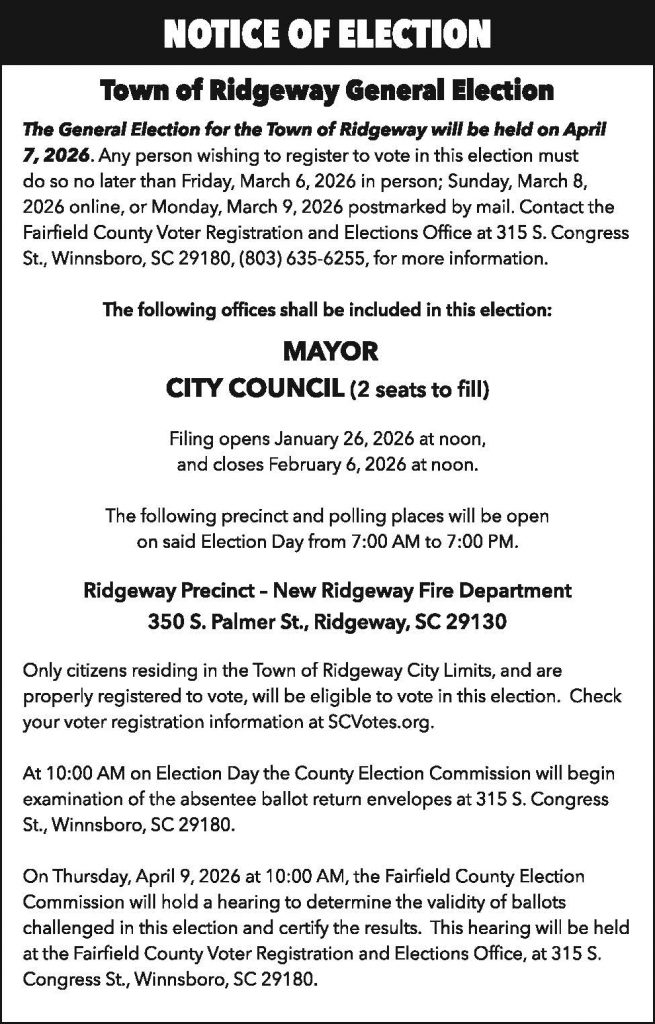
If Fairfield County Council votes to hold a referendum on the tax, it would be voted on during the November 2026 general election. But first, the county would have to submit the referendum language to the Election Commission by Aug. 17, 2026. If the referendum is approved by a simple majority of voters (at least 50 percent + 1 vote), the tax would take effect on May 1, 2027, and, if passed, could run for up to eight years before expiring.
The Speed of Trust
“A wise person said we move at the speed of trust, and a lot of times there’s just no trust out there,” Dixon said. “You’ve got to be will ing to sit with people who disagree with you and stay in the room for the greater good of the county.”
Sumter’s first attempt at a recreation-only penny in 2006 failed, he said. Two years later, county and city leaders regrouped, studied what Orangeburg County had done successfully, and broadened the project list and the coalition behind it.
The penny finally passed in 2008 with about 51 percent of the vote, then passed again in 2014 by a wider margin.
Even so, when Sumter leaders came back to voters for a third round in 2022, they lost.
“We weren’t hearing anything negative. So, we said, okay, everybody gets it, right? We were wrong,” Dixon said. “It was a calamity of errors.”
“Something may have been overlooked in 2022,” McCormick said, “when new leadership took it for granted and relied too heavily on social media. We do social media, but some people are all about social media. Many people want to feel paper and talk to people.
“Take nothing for granted,” he said. “You fight for this just like you do for your own election.”
No public money for campaigning
One lesson Dixon and McCormick stressed repeatedly: once a capital project sales tax question is headed to the ballot, county and town governments must walk a fine legal line.
“The one thing everybody has to know is you cannot spend any public money to influence the outcome of an election,” McCormick said. “That includes staff time – anything that uses public resources.”
Elected officials and staff can – and should – talk about what the penny tax would do, he said, but only to educate, not to advocate from the public dais.
“You wouldn’t stand up at a council meeting and say, ‘Please vote yes,’ because technically you’re on public time,” he said. “But speaking on your own time at Rotary, at church groups, civic clubs – that is not just allowed, it’s necessary. The public needs to know how their leaders feel.”
In Sumter, the Chamber of Commerce and the committee handled the advertising and advocacy.
Rural vs. city – and district vs. district
Fairfield officials pressed the Sumter team on how to navigate tensions between rural and town areas, and between council districts that feel they are getting unequal attention.
Councilman Don Goldbach noted that Fairfield is a small population county with high per-capita revenues, a recent reassessment, and millage increase, and taxpayers are already asking, “You’ve got all this money now – where’s it going? Why do you need more?”
Councilman Carl Bell raised the concern that some districts are more affluent and feel they don’t need a penny tax, while others feel ignored and are looking to see whether their council member will deliver projects for them.
“In my district, I’ve been talking about the penny tax,” Bell said. “If it gives the people in my district what they need, they’re all for it. So how is it going to benefit each and every district, not just certain parts of the county?”
“It’s just human nature for people to ask, ‘What’s in it for me?’ especially when you’re asking them for money,” Dixon said. “Don’t run from that – expect it and address it.”
Sumter’s first successful penny set aside relatively small but visible projects – such as rural community centers and recreation facilities – in outlying areas that had long felt overlooked.
Dixon talked about strategy
“In the big scheme of things, we spent less than $2 million out of about $79 million in those communities,” Dixon said. “But that little community center was everything to them. Those votes from rural areas are what put us over the top.”
At the same time, he said, some projects – like public safety radios and emergency communications – are inherently county-wide.
“That’s not a district question,” he said. “Everybody benefits when a 911 call goes through and the radios work.”
McCormick said council members have to think both like district representatives and like county-wide leaders.
“You can be morally right and it never passes,” he said. “So we’ve got to find a way, if council wants to do it, to get it passed.
“If the project list goes forward, you want to know it’s going to make your county better as a whole, even if one person is throwing rocks at you the whole time.”
Picking projects – and staying together
Dixon said the way Sumter structures its project list has evolved. Early on, a small group of county and city officials worked up the list largely in-house. Later efforts included community meetings in rural areas to confirm priorities.
“Truthfully, we already knew what most of those needs were – roads, fire stations, equipment, recreation,” he said. “The value of those meetings is that people felt engaged and heard, and that matters.”
He urged Fairfield’s council to have hard, honest conversations behind closed doors before anything goes public.
“There will be projects eliminated before it ever comes out,” he said. “That’s a hard conversation for council, but you’ve got to work through it together. And once you come out with a list, you’ve got to be 100 percent behind it.”
Sumter, he said, has seen what happens when one member breaks ranks and campaigns against the package because they didn’t “get enough” for their district.
“If y’all come out half-split on this, it’s not going to succeed,” he warned. “You don’t have to love every single project, but the message has to be: we only move forward if we move forward together.”
A Finite Tax
Several Fairfield officials said they regularly hear skepticism that “once government gets a tax, it never goes away” or that promises about how the money will be spent won’t be kept.
Dixon and McCormick said state law is clear: a capital project sales tax must sunset when the authorized years are up or when the voter-approved projects are paid for – whichever comes first – and the money can only be spent on the specific list that appears on the ballot.
“It’s exactly this list and nothing else,” McCormick said. “We can say eight years, but if you collect enough to finish the projects in seven, it ends in seven. You can’t just keep collecting.”
They pointed to another county where officials were prosecuted for diverting penny tax revenue to projects that weren’t on the ballot.
“They got caught,” one Fairfield official noted. “There are very real teeth to the law. So it’s got to be spent the way the public is told.”
‘Tax avoidance’ and outside money
Dixon and McCormick advised ways to get around roadblocks to passage of the tax.
For conservative voters worried about higher taxes, McCormick said he often frames the penny as a way to avoid steeper property tax hikes on items government will have to buy anyway – such as multimillion-dollar public safety radios.
Because of Fairfield’s interstate exits and planned nuclear plant reconstruction, County Administrator Vic Carpenter told council the county could see an unusually large share of penny tax collections coming from out-of-county and out-of-state buyers – and possibly enough construction purchases to finish projects in fewer than eight years.
As Fairfield County weighs whether to move forward toward a 1-cent referendum, Dixon left council with one final reminder from Sumter’s hard-won experience.
“If we don’t do it, we know what nothing looks like,” he said. “If we do it and we do it together, we may not all get everything we want – but we all win, or we all lose.”