

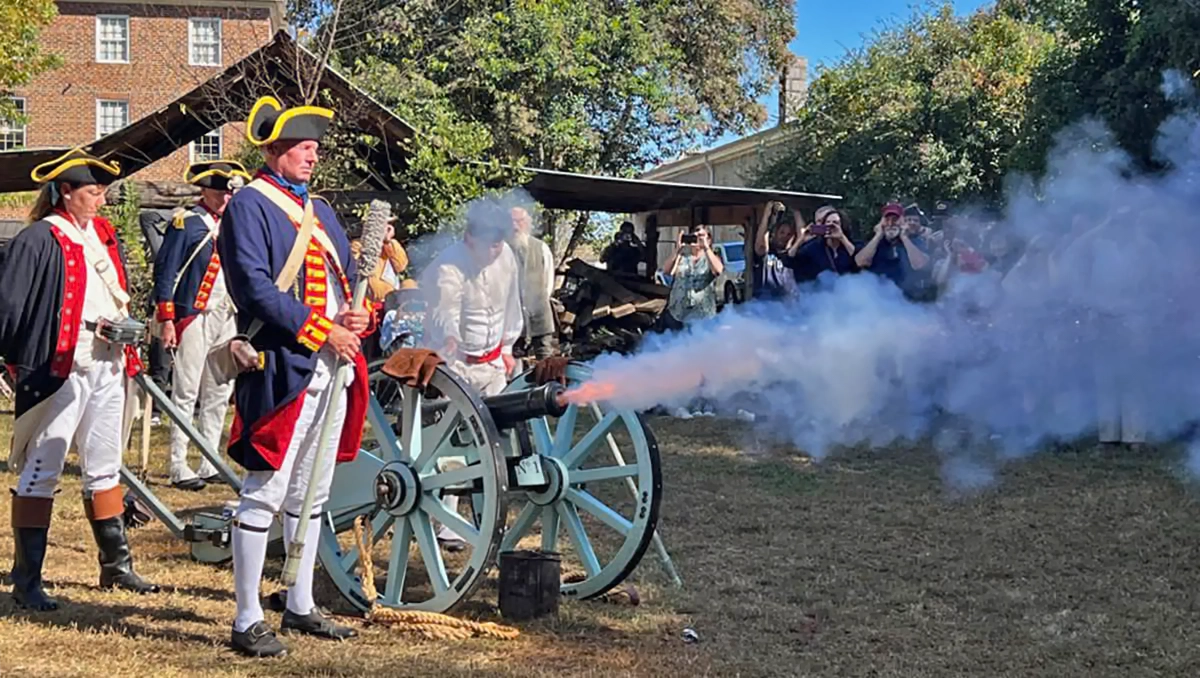
WINNSBORO – On April 25, 2026, Fairfield County will host a major historical celebration titled “Fairfield in the Revolution: Stories of the Backcountry” to commemorate the 250th anniversary of American independence from Great Britain. The event is located at 214 Hudson St. and Saturday’s event runs from 10 a.m. to 5 p.m. and Sunday’s is set for 12 p.m. to 3 p.m.
The weekend focuses on the area’s colonial people and events in the place that we now know as Fairfield County. The event is being held on the green at the historical Mt. Zion campus where British Lord General Cornwallis‘s several hundred army regulars camped during the winter of 1780–81. The little eighteenth-century school there was named the Mt. Zion Institute. The site now is known as Winnsboro’s War Memorial Park and the Mt. Zion Green Trail.
The SC American Revolution 250th Commission, Fairfield County Council, Fairfield County Chamber of Commerce, Fairfield County Museum, Fairfield County 250 Committee, and volunteers from the community are joining forces to produce the event. Activities will feature civilian life reenactors, artillery musters and musket firing demonstrations, cavalry troops on horseback, a visit by George Washington, and historical skits involving Lord Cornwallis, Reverend William Martin, Richard Winn, and other historic figures. In addition, an African American troupe will depict the lifestyle and culture of the period. There will be food trucks, period-themed vendors, and kids’ activities.
In addition, the Fairfield County Museum at 231 S. Congress St. will open an in-house exhibit on April 25 (10 AM-2 PM) featuring research conducted by volunteers and staff of the museum. The show will depict the local traditions about Lord Cornwallis’s three-month winter residence in Winnsboro and will remain on display until December.
The Enemy in Winnsboro
On Oct. 29, 1780, after an unexpected defeat on the battlefield of King’s Mountain, the enemy arrived in Winnsboro in the form of several hundred British regulars under the command of British Army General Charles Lord Cornwallis. He planned his campaign in South Carolina as part of the British “Southern Strategy” to win the Revolutionary War by exploiting perceived strong Loyalist support in the South. His headquarters was set in the small village then called Winnsborough.
After a major defeat of the American Continental Army at the Battle of Camden on August 16, Lord Cornwallis chose Winnsboro as a strategic location adjacent to Francis Lord Rawdon’s post at Camden. The bounteous farmland would be relied on to feed the more than 4000 strong army of British regulars and Loyalist militia men across the district. The village was also on the strategic route of British retreat from their October 7 rout at King’s Mountain and safely closer to other British-held areas.
The winter proved a difficult time for the English who were recovering from the loss at the Battle of King’s Mountain. The British presence in Winnsboro was marked by hardship, with five or six hundred troops plagued by illness and increased pressure from local Patriots. The soldiers were encamped across the center of the town and the campus of Mt. Zion where a small village school was located. Officers and some lucky soldiers were “quartered” in the homes of the villagers. Some slept in “ordinaries” or taverns, two of which have been identified from old records. The British camp at Winnsboro was not particularly comfortable for the soldiers of lower ranks who slept in crude accommodations or in tents on the Mt. Zion open land.
Lord Cornwallis is said to have lived in a small masonry building that was, in later decades, enlarged to the present form of the house at 127 N. Zion St., as seen in this 1910 photograph. Some documentation and circumstantial evidence points to the story’s probable truth. The museum shows several period photographs of the present “Cornwallis House” and evidence of the deed chains and historical accounts which have been sought out and studied by Ed Gates, Ken Shelton, Greydon Maechtle, Betty Carol Luffman, and Eddie Killian.
Another local legend merits mention here: Contrary to many years of tradition, Cornwallis was not the originator for Fairfield County’s name. The winter weather and disappointing military defeats at King’s Mountain on October 7 and Cowpens on January 17 would not have given such pleasantries to the British impressions. The area’s Patriots had already used the name of the Fairfield Militia Regiment in February 1775 before the British arrival in the area. Often associated with the Camden District during the Revolutionary War, the regiment organized shortly after the South Carolina Provincial Congress and the Council of Safety had established the state’s militia units on January 17, 1775. Key commanders included Colonel Joseph Kershaw, Colonel John Winn, and Colonel Richard Winn.